

Texas Instruments TDA4VM/TFA4VM-Q1 Jacinto™ Arm® Based Processors

Texas Instruments TDA4VM/TFA4VM-Q1 Jacinto™ Arm® Based Processors are based on the evolutionary Jacinto 7 architecture, targeted at ADAS and Autonomous Vehicle (AV) applications. These processors are built on extensive market knowledge accumulated over a decade of TI’s leadership in the ADAS processor market. The unique combination of high-performance compute, deep-learning engine, dedicated accelerators for signal and image processing in a functional safety compliant targeted architecture make the TDA4VM devices an excellent fit for several industrial applications. These applications include robotics, machine vision, radar, and so on.
The Texas Instruments TDA4VM/TFA4VM-Q1 provides high-performance compute for traditional and deep learning algorithms at industry-leading power/performance ratios. These devices come with a high level of system integration to enable scalability and lower costs for advanced automotive platforms supporting multiple sensor modalities in centralized ECUs or stand-alone sensors. Key cores include next-generation DSP with scalar and vector cores, dedicated deep learning, and traditional algorithm accelerators. These devices also include Arm and GPU processors for general compute, an integrated next-generation imaging subsystem (ISP), video codec, Ethernet hub, and isolated MCU island. Automotive-grade safety and security hardware accelerators protect all. TFA4VM-Q1 devices are AEC-Q100 qualified for automotive applications.
Features
- Processor cores
- C7x floating point, vector DSP, up to 1.0GHz, 80 GFLOPS, 256 GOPS
- Deep-learning matrix multiply accelerator (MMA), up to 8 TOPS (8b) at 1.0GHz
- Vision Processing Accelerators (VPAC) with Image Signal Processor (ISP) and multiple vision assist accelerators
- Depth and Motion Processing Accelerators (DMPAC)
- Dual 64-bit Arm Cortex-A72 microprocessor subsystem at up to 2.0GHz
- 1MB shared L2 cache per dual-core Cortex-A72 cluster
- 32KB L1 DCache and 48KB L1 ICache per Cortex-A72 core
- Six Arm Cortex-R5F MCUs at up to 1.0GHz
- 16K I-Cache, 16K D-Cache, 64K L2 TCM
- Two Arm Cortex-R5F MCUs in isolated MCU subsystem
- Four Arm Cortex-R5F MCUs in general compute partition
- Two C66x floating-point DSP, up to 1.35GHz, 40 GFLOPS, 160 GOPS
- 3D GPU PowerVR Rogue 8XE GE8430, up to 750MHz, 96 GFLOPS, 6 Gpix/sec
- Custom-designed interconnect fabric supporting near max processing entitlement
- Memory subsystem
- Up to 8MB of on-chip L3 RAM with ECC and coherency
- ECC error protection
- Shared coherent cache
- Supports internal DMA engine
- External Memory Interface (EMIF) module with ECC
- Supports LPDDR4 memory types
- Supports speeds up to 3733MT/s
- 32-bit data bus with inline ECC up to 14.9GB/s
- General-Purpose Memory Controller (GPMC)
- 512KB on-chip SRAM in the MAIN domain, protected by ECC
- Up to 8MB of on-chip L3 RAM with ECC and coherency
- Functional Safety
- Functional Safety-Compliant targeted (on select part numbers)
- Developed for functional safety applications
- Documentation available to aid ISO 26262 functional safety system design up to ASIL-D/SIL-3 targeted
- Systematic capability up to ASIL-D/SIL-3 targeted
- Hardware integrity up to ASIL-D/SIL-3 targeted for MCU Domain
- Hardware integrity up to ASIL-B/SIL-2 targeted for Main Domain
- Safety-related certification
- ISO 26262 planned
- AEC-Q100 qualified on part number variants ending in Q1
- Functional Safety-Compliant targeted (on select part numbers)
- Device security (on select part numbers)
- Secure boot with secure runtime support
- Customer programmable root key, up to RSA-4K or ECC-512
- An embedded hardware security module
- Crypto hardware accelerators – PKA with ECC, AES, SHA, RNG, DES, and 3DES
- High-speed serial interfaces
- Integrated Ethernet switch supporting (total of 8 external ports)
- Up to eight 2.5Gb SGMII
- Up to eight RMII (10/100) or RGMII (10/100/1000)
- Up to two QSGMII
- Up to four PCI-Express (PCIe) Gen3 controllers
- Up to two lanes per controller
- Gen1 (2.5GT/s), Gen2 (5.0GT/s), and Gen3 (8.0GT/s) operation with auto-negotiation
- Two USB 3.0 dual-role device (DRD) subsystem
- Two enhanced SuperSpeed Gen1 Ports
- Each port supports Type-C switching
- Each port independently configurable as a USB host, USB peripheral, or USB DRD
- Integrated Ethernet switch supporting (total of 8 external ports)
- Automotive interfaces
- Sixteen Modular Controller Area Network (MCAN) modules with full CAN-FD support
- Two CSI2.0 4L RX plus One CSI2.0 4L TX
- 2.5Gbps RX throughput per lane (20Gbps total)
- Display subsystem
- One eDP/DP interface with Multi-Display Support (MST)
- HDCP1.4/HDCP2.2 high-bandwidth digital content protection
- One DSI TX (up to 2.5K)
- Up to two DPI
- One eDP/DP interface with Multi-Display Support (MST)
- Audio interfaces
- Twelve Multichannel Audio Serial Port (MCASP) modules
- Video acceleration
- Ultra-HD video, one (3840 × 2160p, 60fps), or two (3840 × 2160p, 30fps) H.264/H.265 decode
- Full-HD video, four (1920 × 1080p, 60fps), or eight (1920 × 1080p, 30fps) H.264/H.265 decode
- Full-HD video, one (1920 × 1080p, 60fps), or up to three (1920 × 1080p, 30fps) H.264 encode
- Flash memory interfaces
- Embedded MultiMediaCard Interface ( eMMC™ 5.1)
- Universal Flash Storage (UFS 2.1) interface with two lanes
- Two Secure Digital 3.0/Secure Digital Input Output 3.0 interfaces (SD3.0/SDIO3.0)
- Two simultaneous flash interfaces configured as
- One OSPI and one QSPI flash interfaces
- or one HyperBus™ and one QSPI flash interface
- System-on-Chip (SoC) architecture
- 16nm FinFET technology
- 24mm × 24mm, 0.8mm pitch, 827-pin FCBGA (ALF), enables IPC class 3 PCB routing
- TPS6594-Q1 Companion Power Management ICs (PMIC)
- Functional Safety support up to ASIL-D
- Flexible mapping to support different use cases
Applications
- Advanced surround view and park assistance systems
- Autonomous sensor fusion/perception systems including camera, radar, and LiDAR sensors
- Mono and multi-sensor Front camera systems
- Next-generation eMirror systems
- Industrial mobile robot (AGV/AMR) with safety functions
- Machine vision
- Smart retail
- Smart shopping cart
- Construction and agriculture
- Edge AI BOX
- Single Board Computer
- Off-highway vehicle control
- Industrial PC with AI
Videos
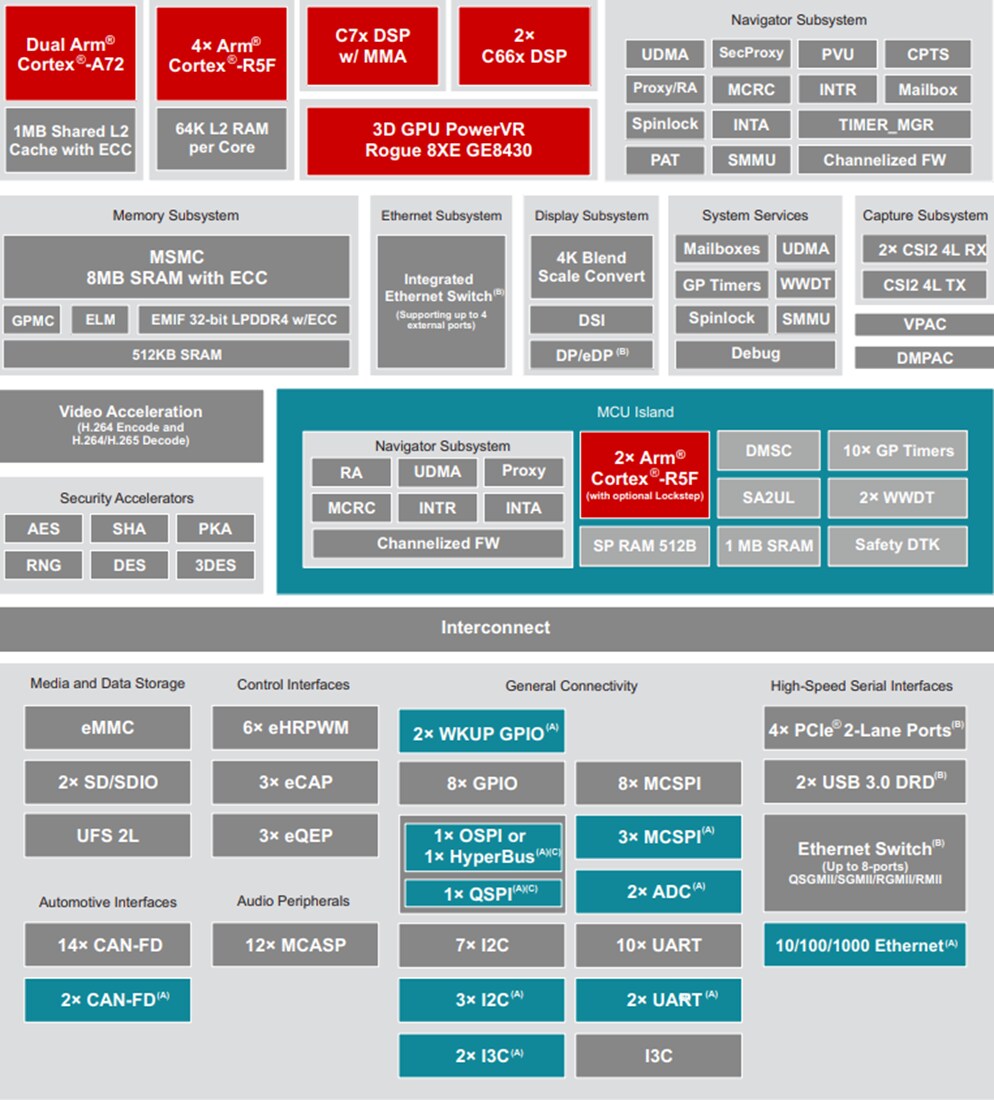
Functional Block Diagram